Guide
Which stadium seats get sun and which get shade
Seats go into shade when the sun is at their backs, so the direction a field points and the sun's position at game time decide who sits in sun. Most big-league parks aim north to northeast, and at the 13 open-air ones aimed up to 46° the third-base side has more shade than the first-base side from 3:18 pm at the latest on the three dates I checked; at the six aimed south of east, from Pittsburgh to Detroit, the first-base side has more all afternoon. On a north–south football field the west sideline is the shaded one from early afternoon on.
What the baseball rule says
Rule 2.01 of MLB's Official Baseball Rules, 2026 edition reads: "It is desirable that the line from home base through the pitcher's plate to second base shall run East-Northeast." Bearings here are compass directions in degrees clockwise from north, so east-northeast is 67.5°, and the ENE point of a 16-point compass covers 56.25° to 78.75°. A batter facing that way has the afternoon and evening sun at his back.
Where real fields point
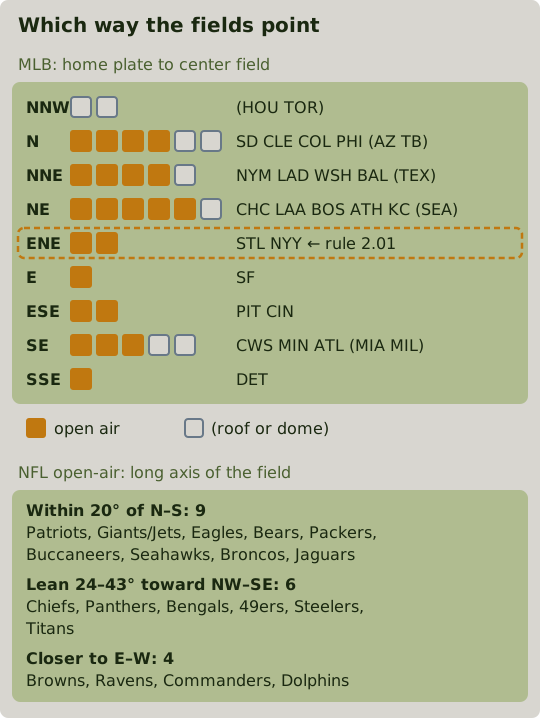
MLB's Stats API lists a bearing for every park (the azimuthAngle field, which I read as the direction from home plate to center field). Figure 1 sorts the 30 current parks by compass point. Only Busch Stadium (62°) and Yankee Stadium (75°) fall inside the ENE point. Seventeen aim N, NNE or NE. Eight aim south of east, as far round as 150° at Comerica Park. The other three are Oracle Park, aimed east at 85°, and Houston and Toronto, both roofed and aimed north-northwest. Eight of the 30 have a roof or dome, which leaves 22 open-air parks.
For football I measured the long axis of the field outline at the 19 open-air NFL stadiums whose fields are mapped in OpenStreetMap (Figure 1, bottom). Nine run within 20° of north–south and six lean 24–43° toward northwest–southeast, the alignment Pennsylvania's field and court orientation guide recommends for football played mostly in the fall; the other four (Cleveland, Baltimore, Washington and Miami) are closer to east–west.
The sun at first pitch
I computed the sun's position with the site's sun-position code, an implementation of NREL's Solar Position Algorithm that also runs the sun position calculator. It gives the sun's azimuth, its compass direction measured the same way as the park bearings, and its elevation, the angle above the horizon. I ran it for 1:10 and 7:10 pm, two common MLB start times, on the 15th of April, July and September 2026. Clock times are daylight saving time. San Diego, the southernmost open-air park, is the low-latitude case.
A roof edge or upper-deck rim h meters above a row of seats casts a shadow h / tan(elevation) long. Shade depth is how far that shadow reaches into a section, measured from the point under the edge toward the field. The table uses an illustrative h = 20 m (66 ft); shadows and shade depths scale with h, so for a 10 m overhang, halve them.
| City, date | Sun at 1:10 pm (azimuth / elevation) | Shadow of a 20 m edge at 1:10 pm | Sun at 7:10 pm (azimuth / elevation) | Sunset |
|---|---|---|---|---|
| Boston, Apr 15 | 192° / 57° | 13 m | 282° / 2° | 7:26 pm |
| Boston, Jul 15 | 193° / 69° | 8 m | 289° / 11° | 8:19 pm |
| Boston, Sep 15 | 192° / 50° | 17 m | below horizon | 6:54 pm |
| Kansas City, Apr 15 | 176° / 61° | 11 m | 277° / 8° | 7:55 pm |
| Kansas City, Jul 15 | 169° / 72° | 6 m | 285° / 16° | 8:43 pm |
| Kansas City, Sep 15 | 179° / 54° | 15 m | 272° / 3° | 7:26 pm |
| San Diego, Apr 15 | 193° / 67° | 9 m | 281° / 1° | 7:19 pm |
| San Diego, Jul 15 | 198° / 78° | 4 m | 290° / 8° | 7:57 pm |
| San Diego, Sep 15 | 193° / 59° | 12 m | below horizon | 6:54 pm |
Solar noon (the sun due south) falls between 12:40 pm and 1:24 pm at these parks, so at a 1:10 pm first pitch the sun is high, 50–78° up, and little is in shade. A 7:10 pm start in mid-September in Boston or San Diego comes after sunset.
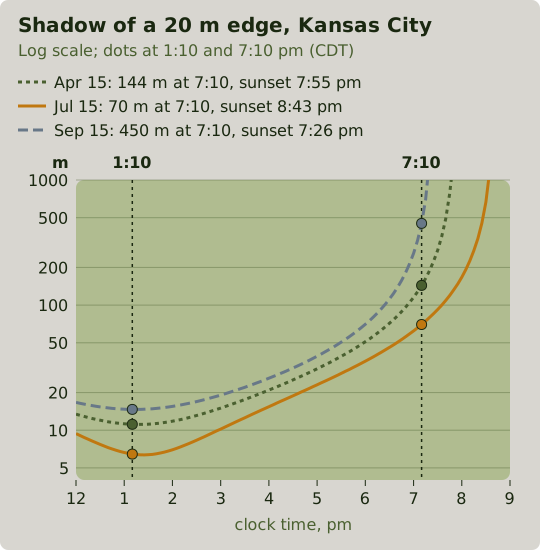
Figure 2 follows that shadow in Kansas City. It stays under 20 m until 3:10 pm in September, 3:52 pm in April and 4:39 pm in July.
How a stand shades its own seats
A shadow falls directly away from the sun. A section's shade depth is the shadow length times the cosine of the angle between the sun's azimuth and the direction straight back from the seats, and it is zero when the sun is in front of the seats. For stands along the two foul lines this reduces to one test. Draw the line from center field through home plate and extend it past home plate; whichever side of that line the sun is on, the stands on that side have it more squarely at their backs and get the deeper shade. To turn meters into rows I take a row as 33 in (0.84 m) front to back, the 33 in tread an aluminum-grandstand manufacturer's specification gives for seats with backs.
Figure 3 applies the test to a hypothetical park built exactly to the rule at Kansas City's latitude, with the sun's track for July 15; Kauffman Stadium itself points 46°. The sun is on the first-base side of the line until 3:35 pm, when it is directly behind home plate, and on the third-base side from then until sunset. I call that moment the crossover: from then on the third-base stands get more shade than the first-base stands.
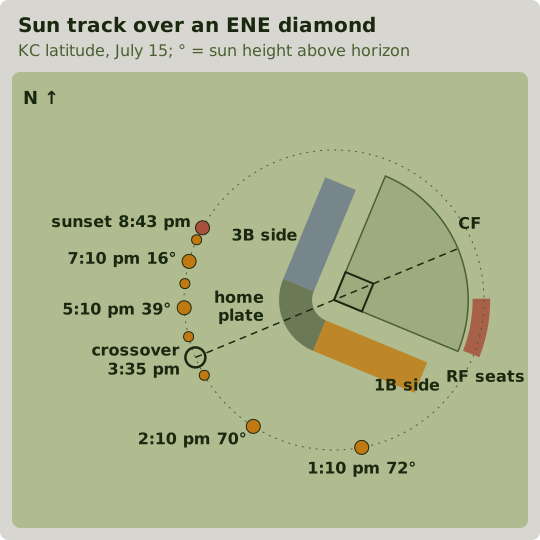
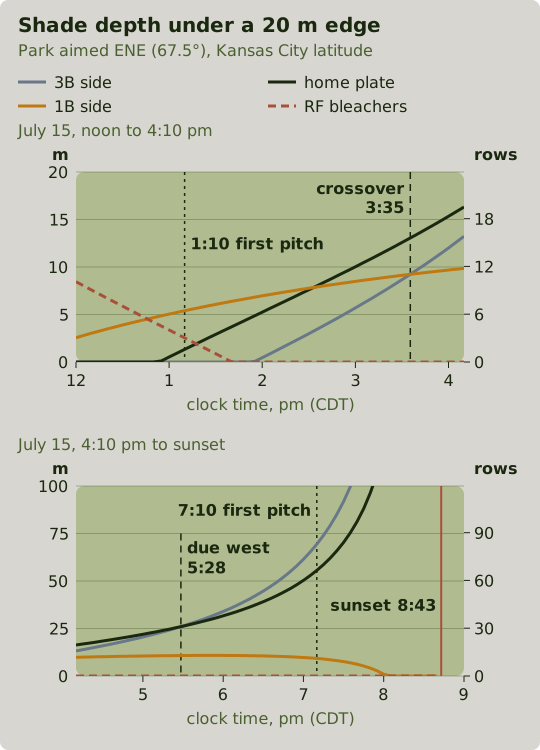
Figure 4 gives the July shade depths. At a 1:10 pm first pitch the first-base side has 5.4 m, about 6 rows, against 2.5 m for the right-field bleachers, 1.3 m for the home-plate seats and none for the third-base side. The section with the most shade is the first-base side until 2:33 pm, the home-plate seats from 2:33 to 5:28 pm, and the third-base side after 5:28 pm, when the sun is due west. The third-base side passes the first-base side at the 3:35 pm crossover. At a 7:10 pm first pitch the third-base side is shaded 69 m deep and the home-plate seats 56 m, enough to cover every row of a section under that edge; the first-base side has 9 m and never more than 11 m (13 rows). From 1:40 pm the right-field seats face the sun.
In April and September the same park reaches the crossover only at 4:23 and 4:48 pm, so for the whole of a 1:10 pm game the first-base side has more shade than the third-base side, and the home-plate seats lead from 3:00 and 3:15 pm.
The model ignores two things: upper rows sit higher and leave a shadow sooner, and late in the day the home-plate grandstand's long shadow can reach the right-field seats before sunset.
Real parks shift the timing
The crossover comes when the sun's azimuth equals the park's bearing plus 180°. The table gives it for all 22 open-air parks on three dates, in local daylight time.
| Park | Home plate to center field | Apr 15 | Jul 15 | Sep 15 |
|---|---|---|---|---|
| Petco Park, San Diego | 0° | 12:49 pm | 12:55 pm | 12:44 pm |
| Progressive Field, Cleveland | 0° | 1:27 pm | 1:33 pm | 1:22 pm |
| Coors Field, Denver | 4° | 1:08 pm | 1:11 pm | 1:05 pm |
| Citizens Bank Park, Philadelphia | 9° | 1:19 pm | 1:19 pm | 1:18 pm |
| Citi Field, New York | 13° | 1:23 pm | 1:20 pm | 1:23 pm |
| Dodger Stadium, Los Angeles | 26° | 1:38 pm | 1:25 pm | 1:45 pm |
| Nationals Park, Washington | 28° | 2:06 pm | 1:52 pm | 2:13 pm |
| Camden Yards, Baltimore | 31° | 2:12 pm | 1:57 pm | 2:20 pm |
| Wrigley Field, Chicago | 37° | 2:17 pm | 1:58 pm | 2:27 pm |
| Angel Stadium, Anaheim | 44° | 2:15 pm | 1:46 pm | 2:31 pm |
| Fenway Park, Boston | 45° | 2:35 pm | 2:11 pm | 2:48 pm |
| Sutter Health Park, Sacramento | 46° | 2:50 pm | 2:22 pm | 3:05 pm |
| Kauffman Stadium, Kansas City | 46° | 3:03 pm | 2:35 pm | 3:18 pm |
| Busch Stadium, St. Louis | 62° | 3:40 pm | 2:57 pm | 4:04 pm |
| Yankee Stadium, New York | 75° | 4:43 pm | 3:53 pm | 5:10 pm |
| Oracle Park, San Francisco | 85° | 5:45 pm | 4:43 pm | 6:18 pm |
| PNC Park, Pittsburgh | 116° | never | 8:28 pm | never |
| Great American Ball Park, Cincinnati | 122° | never | never | never |
| Rate Field, Chicago | 127° | never | never | never |
| Target Field, Minneapolis | 129° | never | never | never |
| Truist Park, Atlanta | 145° | never | never | never |
| Comerica Park, Detroit | 150° | never | never | never |
At the six parks aimed within 26° of north the crossover comes by 1:45 pm on all three dates, so the third-base side has more shade than the first-base side for nearly all of a 1:10 pm game. Further east the crossover is earliest in midsummer: Yankee Stadium's moves from 3:53 pm in July to 4:43 pm in April and 5:10 pm in September. PNC Park reaches it only in July; in mid-April and mid-September the Pittsburgh sun sets at 284° and 274°, short of the 296° it needs. At the five parks aimed 122° or more it never comes, and the first-base stands carry more shade than the third-base stands all afternoon.
Football: which stands get the shade
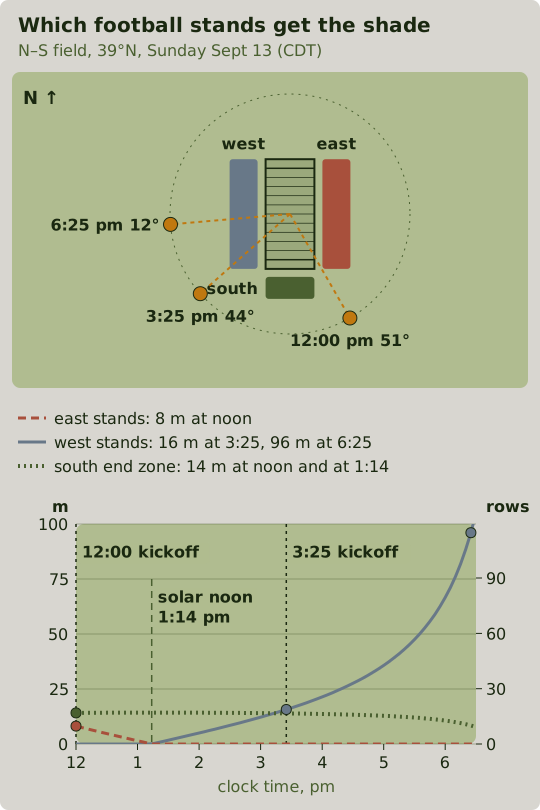
The sideline stands of a north–south field face east and west. Figure 5 uses Sunday, September 13, 2026 at Kansas City's latitude, with kickoffs at noon and 3:25 pm Central. Solar noon that day is 1:14 pm. Before it the sun is east of south and the east stands have 8 m of shade at the noon kickoff, with none on the west side. The south end-zone stands, which face north, do better than either sideline until mid-afternoon: 14 m at the noon kickoff and at solar noon, and more than the west stands until 3:13 pm. After solar noon the west stands gain shade for the rest of the day, 16 m at the 3:25 pm kickoff and 96 m by 6:25 pm, while the east stands look into the sun.
How to check a seat for a given game
- Find the field's bearing: the table above for big-league parks, or the line from home plate to center field (or the long axis of a football field) on any map.
- Look up the sun's azimuth and elevation for the date and the local first-pitch or kickoff time on the sun position calculator.
- Extend the line from center field through home plate (for football, the long axis). Stands on the same side of it as the sun get the deeper shade, and stands on the other side are closer to facing the sun.
- Work out which way your seats face: first-base-line seats face the park's bearing minus 45°, home-plate seats the bearing, third-base-line seats the bearing plus 45°, and football sideline stands the long axis plus or minus 90°. Straight back is that direction plus 180°. Shadow length = height of the roof edge above your row ÷ tan(sun elevation); estimate the height as the rows back to the row under the edge times the rise per row (8 or 13 in in the aluminum-grandstand spec, so steeper concrete stands differ), plus the edge's height above that row. Shade depth = shadow length × cos(angle between the sun's azimuth and straight back); if it is more than your row's distance from the edge, you are in shade. At Kauffman (46°), first-base-line seats face 1°, so straight back is 181°; at 1:10 pm on July 15 the sun is at 169° and 72° up, a 20 m edge casts 6.5 m, and cos 12° gives 6.3 m, about 7.5 rows.
The Stadium Shade tool on this site shows these shadows in 3D for a chosen stadium, date and start time.